- B2 ✏︎ Cells -
B2.1 - Cell Membrane Structure (SL/HL)
LECTURE VIDEO
DESCRIPTION
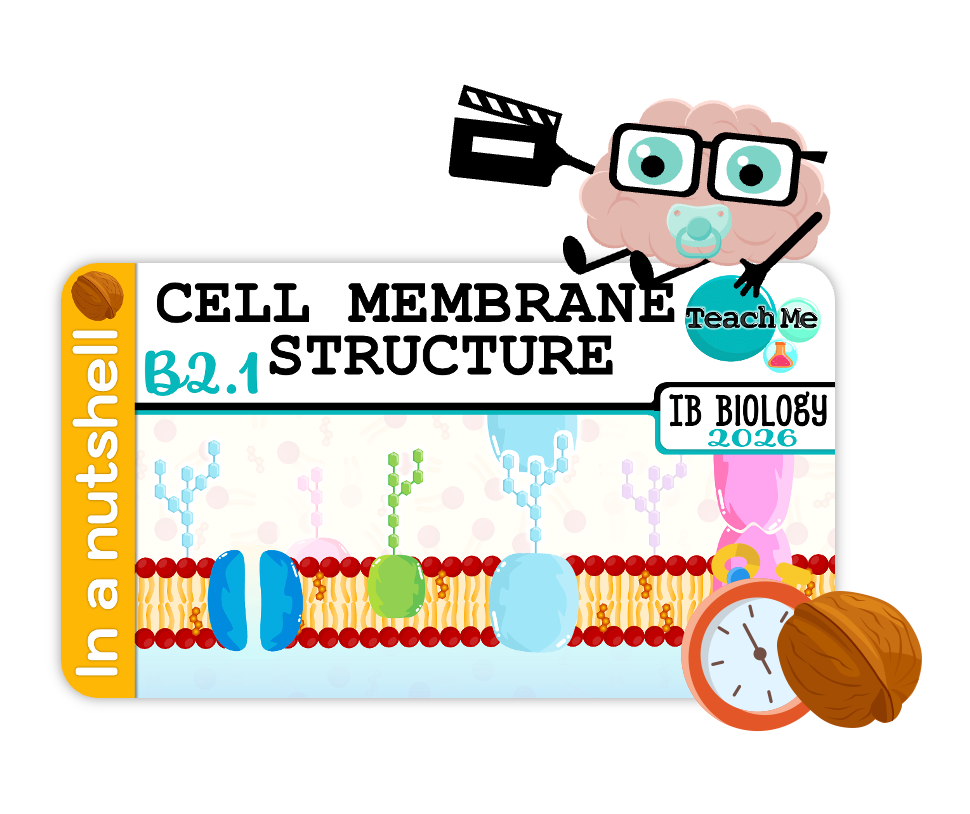
Forget brick walls—your cells are guarded by a bouncer made of fat who can’t make up his mind.
This video on Membrane Structure is your backstage pass to the Fluid Mosaic Model, the greasy, protein-studded VIP lounge of life itself. We’re diving deep to explain:
- The Phospholipid Bilayer: Meet the fickle bouncers—hydrophilic heads who love water, and hydrophobic tails who absolutely despise it. Their identity crisis is the foundation of all life.
- Cholesterol: The cell’s very own mood manager. Is it too fluid? Too rigid? Cholesterol is there to stabilise the drama and keep the membrane from having a meltdown.
- Membrane Proteins: The polymaths, who simply have too many skills.
- Glycolipids & Glycoproteins: The cell’s fancy nametags and recognition system.
Stop seeing the membrane as a static wall and start seeing it for what it is: a dynamic, ever-changing party that keeps you alive.
TIMESTAMPS
STUDY RESOURCES
00:00 – Intro
00:13 – Overview Of This Video
00:43 – Phospholipid Bilayer
09:29 – Formation Of A Phospholipid Bilayer
13:22 – The Fluid Mosaic Model
23:58 – Role Of Membrane Proteins
32:50 – Glycoproteins & Glycolipids
36:54 – Brief History Of Membranes
39:38 – Questions & Answers
47:38 – Outro
B2.1 - Cell Membrane Transport (SL/HL)
LECTURE VIDEO
DESCRIPTION
They’re not just bouncers at the club of life (keeping the riff-raff out)—they’re sophisticated doormen, revolving doors, and emergency exits all in one. Dive into the bustling city that is the cell membrane, where the traffic never stops!
This video pumps up the volume to explain:
- Simple & Facilitated Diffusion: From the laid-back O₂ just strolling through, to the glucose that needs a fancy protein doorman to let it in.
- Active Transport: The molecular superhero that defies gravity (and concentration gradients) using pure ATP energy. Someone’s gotta work the night shift!
- Osmosis: The dramatic saga of water, where it decides to throw a pool party in a cell or abandon it for a desert, leading to cells looking either plump or pruney.
We’ll cut through the semi-permeable mystery to show you how your cells manage the ultimate logistics operation. No ticket required, just bring your curiosity
TIMESTAMPS
STUDY RESOURCES
00:00:00 – Intro
00:00:12 – Overview Of This Video
00:01:22 – Simple Diffusion
00:22:33 – Facilitated Diffusion
00:35:43 – Osmosis
00:41:17 – Osmosis V.S Facilitated Diffusion
00:44:04 – Osmosis In Animal Cells
00:49:04 – Active Transport
00:58:41 – High Yield Summary
01:04:06 – Questions & Answers (#1, #2, #3, #4, #5)
01:08:56 – Outro
NOTES – All you need to know in one place!
QUESTIONS – Test your Big Brain!

B2.1 - Fluidity & Adhesion (HL)
LECTURE VIDEO
DESCRIPTION
Forget rigid walls. Your cell membrane is a dynamic, ever-changing sea of phospholipids where fluidity is everything—and without the right “stickiness,” your entire body would just be a puddle of lonely cells.
This video dives into the molecular party on the cell’s surface, exploring how it stays perfectly flexible yet stable, and how cells decide who to hang onto in the crowded tissue nightclub.
This video breaks down the fluid dynamics and social glue of cells:
- The Phospholipid Bilayer: The Liquid Dance Floor – It’s not a solid. It’s a “fluid mosaic” where phospholipids can slide, spin, and do the lateral shuffle. This flexibility is non-negotiable for everything from cell division to vesicle formation.
- Cholesterol: The Bouncer & Temperature Buffer – The ultimate membrane regulator. At high temps, it restrains phospholipid movement, preventing the dance floor from becoming a chaotic mess. At low temps, it prevents tight packing, stopping the membrane from freezing solid. It’s the ultimate stabilizer.
- Cell Adhesion Molecules (CAMs): The Social Velcro – How do cells recognize each other and stick together to form tissues? Proteins like cadherins act like specific molecular handshakes, binding cells to their neighbors. No CAMs = no tissues, no organs, just a sad cellular soup.
Understand the delicate balance of flexibility and connection that lets trillions of cells move, communicate, and stick together to build a functional you.
TIMESTAMPS
STUDY RESOURCES
00:00 – What is Membrane Fluidity?
01:51 – Why Membrane Fluidity?
03:46 – Phospholipid Structure & Types
09:35 – Saturated Fatty Acids & Fluidity
12:45 – Unsaturated Fatty Acids & Fluidity
15:02 – High Temperature & Phospholipid Fluidity
18:23 – Low Temperature & Phospholipid Fluidity
19:54 – Summary (Phospholipid & Fluidity)
23:10 – Cholesterol & Fluidity (Required)
25:47 – Cholesterol & Fluidity (Extra)
31:17 – Cell & Organelle Membrane Difference
33:18 – Fatty Acid Desaturase (Bacteria)
36:01 – Quick Recap
36:55 – Cell Adhesion Molecules (CAM)
40:41 – Questions & Answers
NOTES – All you need to know in one place!
QUESTIONS – Test your Big Brain!
B2.1 - Cell Membrane Transport (HL)
LECTURE VIDEO
DESCRIPTION
Your cell membrane isn’t a wall—it’s the world’s smartest checkpoint, running everything from automatic sliding doors to high-energy bouncers and package-swallowing portals.
This video breaks down the elite logistics network that runs your cells, moving cargo with everything from simple channels to ATP-burning pumps and glorious, membrane-engulfing chaos.
This video navigates the cellular customs office:
- Facilitated Diffusion’s “Gates”: The automatic doors for ions and polar molecules. Meet the fancy gated carrier and channel proteins—the bouncers that only open for the right signal (ligand-gated) or the right voltage (voltage-gated). Fast, passive, and selective.
- Active Transport: The Na+/K+ Pump: The ultimate ATP-burning bouncer. It violently evicts 3 sodium ions (Na+) out of the cell and reluctantly lets 2 potassium ions (K+) back in against their gradients. This costly hustle creates the cell’s entire electrochemical battery.
- Indirect Active Transport (Co-Transport): The molecular “hitchhiker” scam. A transporter uses the steep gradient built by the pump (like Na+ rushing back in) to power the uphill transport of a second molecule (like glucose). One solute’s fall fuels another’s rise.
- Bulk Transport: The FedEx & Garbage Disposal: For molecules too big for doors.
- Endocytosis:The cell membrane literally reaches out, wraps around a particle, and swallows it whole.
- Exocytosis:Vesicles fuse with the membrane to dump their cargo (like hormones or waste) outside the cell. It’s the cellular delivery truck.
Understand the layered transport system—from passive gates to active hustle to wholesale engulfment—that keeps the tiny city of your cell alive and in balance.
TIMESTAMPS
STUDY RESOURCES
00:00 – Intro To Membrane Transport
02:00 – Endocytosis
07:46 – Exocytosis
12:50 – Facilitated Diffusion
19:17 – Active Transport
22:56 – Sodium/Potassium Pump
34:21 – Sodium/Potassium Pump (Mechanism-Word Form)
34:43 – Neuron & Membrane Transport (Overall Summary)
46:57 – Indirect Active Transport
54:10 – Myasthenia Gravis (Disease)
55:33 – Questions & Answers
NOTES – All you need to know in one place!
QUESTIONS – Test your Big Brain!
B2.2 - Organelles & Compartmentalization (SL/HL)
LECTURE VIDEO
DESCRIPTION
Your cell isn’t a simple soup. It’s a high-tech, compartmentalized city where every tiny organelle has a job, walls are mandatory, and the nucleus is the mayor in a secure, double-walled bunker.
This video tours the miniature metropolis inside you and reveals the ingenious, sometimes explosive, lab tools scientists use to spy on its citizens and take them apart piece by piece.
This video maps the cellular city and the tools to raid it:
- Organelles 101: What Are They? The specialized, membrane-bound (but not always) structures (the “little organs”) that run the cellular city. Mitochondria = power plants. Ribosomes = factories. Golgi = post office. You get the idea.
- Compartmentalization: Why Walls Are Everything – Separate, incompatible chemical reactions. Create localized concentration gradients. Protect the precious DNA. It’s the reason your cell doesn’t dissolve into a toxic, inefficient puddle.
- The Research Toolbox:
- Microscopes: From light to electron, for seeing the city’s skyline and street layout.
- Centrifugation: The “spin it really fast” tool to separate cell parts by density.
- Gel Electrophoresis: The DNA/RNA/protein sizing rack. Zap them with electricity and watch them race through a gel—smallest fragments win.
- Chromatography: The molecular art of separation by attraction. Different molecules stick to a medium at different rates, creating a colorful chemical fingerprint.
Understand how life organizes its chaos into tiny rooms, and how scientists use physics and chemistry to crack those rooms open and investigate the evidence.
TIMESTAMPS
STUDY RESOURCES
00:00 – Eukaryotes & Compartmentalisation
03:16 – What is NOT an organelle?
08:28 – Purpose Of Compartmentalisation
14:52 – Nucleus & Compartmentalisation
18:40 – Quick Recap
19:40 – Microscope [Tools For Research]
20:35 – Centrifugation [Tools For Research]
22:11 – Chromatography [Tools For Research]
24:24 – Gel Electrophoresis [Tools For Research]
28:32 – Questions & Answers
NOTES – All you need to know in one place!
QUESTIONS – Test your Big Brain!
B2.2 - Organelles & Compartmentalization (HL)
LECTURE VIDEO
DESCRIPTION
Your cell is run by a crew of tiny, specialized experts. Some are ancient, swallowed invaders turned permanent roommates. Others are control freaks, factories, or frantic mail-sorting centers.
This video profiles the cellular power players and their origin stories:
- The Mitochondrion: The Powerhouse -The ATP factory with its own DNA and double membrane. The star evidence (along with the chloroplast) for endosymbiotic theory—it was likely a bacterium swallowed and not digested, becoming a permanent energy slave.
- The Chloroplast: The Solar Panel – The sunlight-to-sugar converter in plants.
- The Nucleus: The Command Bunker – The DNA library that issues all the orders but never leaves the office.
- Ribosomes: The Protein Factories – Not membrane-bound, just ruthless efficiency machines that read mRNA blueprints and assemble amino acids into proteins.
- The Golgi Apparatus: The Post Office – It nurtures a baby protein (from RER) into its best post-puberty self. Then packages them into vesicles, sending them to their final cellular destination. The master of molecular logistics.
- Cellular Vesicles: There are various subtypes:
- Lysosomes: The Garbage Trucks & Recyclers. – Acid-filled sacs of digestive enzymes for waste breakdown.
- Transport Vesicles: The Moving Vans – They shuttle cargo between organelles (like from ER to Golgi).
- Secretory Vesicles: The Export Trucks – They ferry finished products (like hormones) to the membrane for release.
Meet the tiny, complex machines—some ancient, some just overworked—that divide labor to build, power, and run the miracle of a living cell.
TIMESTAMPS
STUDY RESOURCES
00:00 – Eukaryotes Have Organelles
02:21 – What is NOT An Organelle
02:58 – Mitochondria
12:14 – Defect In Mitochondria
14:04 – Microscope & Mitochondria
15:13 – Chloroplast
21:45 – Microscope & Chloroplast
22:41 – Catabolism VS Anabolism
25:14 – Endosymbiotic Theory (Mitochondria & Chloroplast)
28:47 – Nucleus
34:07 – Ribosomes
38:41 – Golgi Apparatus
43:56 – Cellular Vesicles
47:48 – Clathrin & Receptor Mediated Endocytosis
53:25 – Wrap-up
55:10 – Questions & Answers
NOTES – All you need to know in one place!
QUESTIONS – Test your Big Brain!
B2.3 - Cell Specialization (SL/HL)
LECTURE VIDEO
DESCRIPTION
Every one of your cells has the same genetic instruction manual. So how did some become brainy neurons, others become stretchy muscle, and others become transparent eye lenses?
It’s not about reading the whole book (DNA)—it’s about which chapters get bookmarked and which get glued shut forever.
This video maps the cellular career path from blank slate to specialist:
- The Differentiation Dilemma: A liver cell and a skin cell have identical DNA, but each only activatesthe specific genes needed for its job. The rest are silenced. It’s cellular “quiet reading time.”
- Stem Cells: The Ultimate Interns – The undifferentiated, blank-slate cells that can become anything.
- Morphogens: The “This Way to Your Career” Chemicals – The signaling molecules that create concentration gradients in a tissue. A high dose tells a cell to become one thing; a low dose tells it to become another. They’re the ultimate body-patterning GPS.
- Surface Area to Volume Ratio: Why cells are so small. This basic math seen in this video forces multicellular life to be made of many small, specialized cells instead of a few giant, inefficient blobs.
Understand how chemical signals, genetic switches, and simple geometry team up to turn one universal script into the incredible diversity of your body’s workforce.
TIMESTAMPS
STUDY RESOURCES
00:00 – Intro To Cell Specialization
02:31 – Examples Of Different Cell Types
13:03 – Cell Differentiation
16:15 – Morphogens
22:10 – Stem Cells Characteristics
27:09 – Stem Cell Types
33:31 – SUMMARY (Stem Cell Types)
33:53 – Stem Cell Niche
35:43 – PROS & CONS Of Stem Cells
40:26 – Surface Area To Volume Ratio
48:32 – Questions & Answers
NOTES – All you need to know in one place!
QUESTIONS – Test your Big Brain!
B2.3 - Cell Specialization (HL)
LECTURE VIDEO
DESCRIPTION
Your body is built by cellular specialists who have taken their job to an architectural extreme. Some have evolved from basic blobs into biological super-utilities with adaptations that border on ridiculous.
This video showcases the most hardcore structural overachievers in your body and explains why their bizarre forms are the secret to keeping you alive.
Meet some of your body’s elite specialists:
- Kidney Proximal Tubule Cell :The ultimate recycling plant, with a brush border of microvilli creating insane surface area to reclaim every useful drop of nutrient from being lost in your urine.
- Red Blood Cell :The oxygen courier that fired its nucleus to make more room for hemoglobin and shaped itself into a biconcave lifesaver for maximum gas exchange.
- Alveolar Cells :The Type I flatliners for easy gas diffusion vs. the Type II bubble blowers secreting lifesaving surfactant to keep your lungs from collapsing.
- Muscle Cells :Skeletal muscle is a fused, striate and packed with fibers for brute force. Cardiac muscle is a branched, interconnected grid that beats as one unit—no arguments.
- Sperm vs. Egg :The ultimate evolutionary arms race. The sperm is a streamlined, mitochondrial-packed torpedo built for speed. The egg is a giant, nutrient-stocked fortress built for endurance.
Witness how evolution bends the basic cell blueprint into wildly efficient, highly specific, and frankly weird shapes to get the job done.
TIMESTAMPS
STUDY RESOURCES
00:00 – Intro To Cell Specialization
01:26 – Kidney Cells
07:53 – Red Blood Cells
11:39 – Alveoli Cells
20:30 – Cardiac Muscle Cells
23:21 – Skeletal Muscle Cells
27:17 – Intro To Our Gametes
29:03 – Sperm Cells
32:29 – Egg Cells
34:43 – Sperm Vs Egg Adaptations
36:31 – Questions & Answers
NOTES – All you need to know in one place!
QUESTIONS – Test your Big Brain!
COMMENTS